
Read the Instruments in Floyd County Deed Records
A deed is the record that shows who gave up land and who took it. The instrument spells out the transfer language, describes the parcel, and cites the recording reference where the clerk filed it. Instrument type matters a great deal in Floyd County deed records. A warranty deed promises title, while a quitclaim deed passes only whatever the signer had. Security deeds and liens turn up in related recorded systems, but they document claims or collateral rather than a clean change of ownership.
| Deed Type | What It Does | Common Use |
|---|---|---|
| Warranty deed | Conveys the stated interest with warranties | Ordinary arm's-length conveyance |
| Quitclaim deed | Conveys whatever interest the grantor has | Family transfer, correction, claim cleanup |
| Limited warranty deed | Uses narrower warranties stated in the instrument | Some commercial or estate transactions |
| Executor or administrator deed | Conveys under estate authority | Probate-related transfer |
| Tax deed | Records a transfer following a tax sale | Delinquent-tax process requiring further review |
Never trust the label alone. The legal effect hides in the details. Read the reservations, exceptions, easements, survivorship language, consideration, legal description, prior reference, and signatures before drawing any conclusion from a Floyd County deed records entry. Then look for later corrections, releases, cancellations, assignments, or court orders that may change what the instrument actually did.
Floyd PropertyCheck Separates Index From Images
Floyd County runs its document access through Cott PropertyCheck. It is an entry point for indexed-record searches. It also supports recent searches and notifications. Guest access works well for index work. Viewing and printing the documents themselves takes a subscription. Listed terms run one day for $5, one month for $30, three months for $80, and six months for $150. Confirm current pricing before paying.
The login screen below comes from the official Floyd document service.
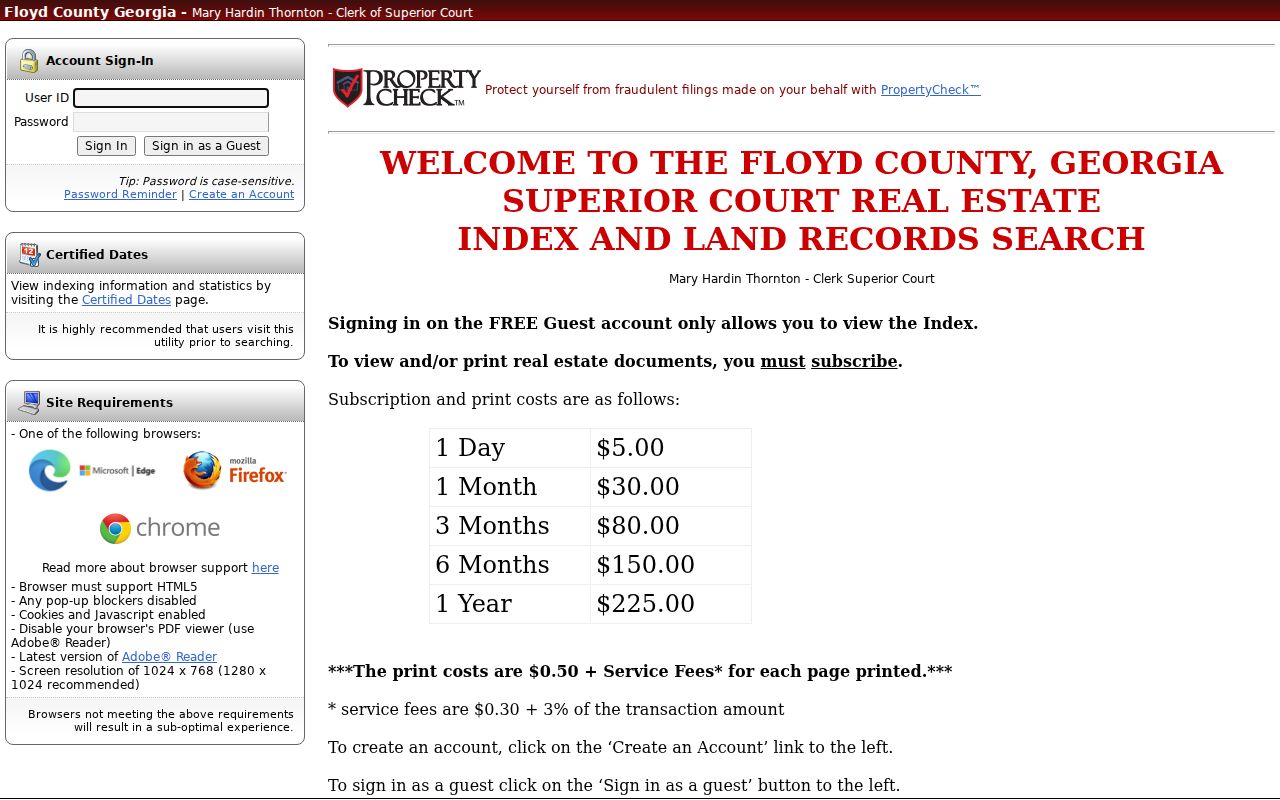
It makes the account gate visible before a researcher commits to image retrieval.
GSCCCA Expands a Floyd County Deed Search
The GSCCCA real estate index widens a Floyd County deed search past the local system. Its filters cover name, book and page, subdivision, unit, block, lot, county, date range, party type, instrument type, and geography. Results list the parties, the property location, and the book/page citation. Statewide deed indexing reaches back to at least January 1, 1999. Older material is thinner and added unevenly, so gaps remain for early years.
| Field | Use in Floyd | Format note |
|---|---|---|
| Name and party type | Separate grantors from grantees | Try initials, entities, trusts, punctuation |
| Book/page | Open a known reference | Copy exactly from card or deed |
| Subdivision, block, lot | Find platted city land | Compare the recorded plat |
| Date and instrument | Narrow transfers or releases | Allow time around closing |
The statewide search menu appears below from the GSCCCA source.
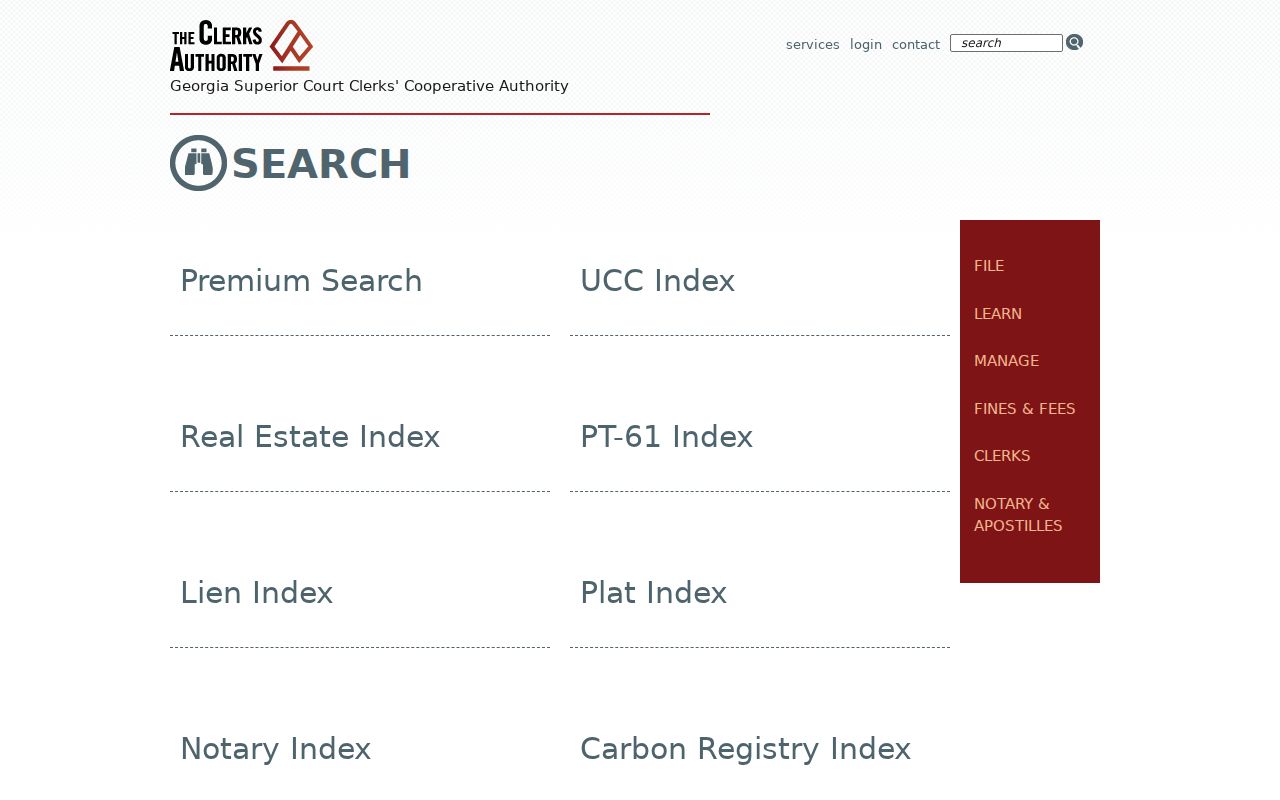
The menu separates deed, lien, plat, and UCC searches into their own paths. Each one pulls a different slice of the Floyd County property records, so treat them as related tools rather than interchangeable searches.
Floyd County Deeds Link to Liens and Plats
A deed rarely stands alone. A Georgia security deed records a lender's interest. A later cancellation or release clears it. Liens, lis pendens, assignments, easements, covenants, and fixture filings can all reshape a parcel's picture. Ownership may look simple on paper while the surrounding record tells a fuller story.
For a subdivision parcel, match the deed's lot and block. Then check it against the plat book and page. Rural Floyd County land works differently. Keep the land lot, district, section, metes-and-bounds calls, and neighboring owners close at hand. The Rome Engineering historical plat page also credits surveys by J.P. Baskin, J.H. Hitchcock, and J.B. Lovell, which can help tie an old plat to a known hand.
Floyd County Fraud Alerts Follow Recorded Names
The statewide FANS service sends notices when a matching name or address shows up in indexed deeds, liens, or plats. PropertyCheck does the same. An alert is not a legal determination. It simply flags something worth a closer look. So pull the instrument and confirm the party, parcel, and recording context before drawing conclusions.
The official GSCCCA services source lays out the statewide options. Keep alert dates and book/page references on file. That way an unfamiliar filing can be described precisely to the Clerk.
Walk Floyd County's Grantor-Grantee Chain
Start from the newest deed backed by the parcel card and legal description. The current owner should show as grantee, with the prior owner as grantor. Then search that prior owner as grantee to find the next acquisition back. Repeat the hop as far as the chain holds. Along the way, log the date, instrument type, book/page, and legal description. Log every prior-deed reference the Floyd County deed records supply.
- Find the current acquisition with the owner as grantee.
- Read the grantor, property description, and prior reference.
- Search that grantor as grantee for the preceding acquisition.
- Move to deed books or microfilm when online coverage ends.
- Grantor
- The party conveying the stated interest.
- Grantee
- The party receiving that interest.
- Chain of title
- The linked sequence of recorded conveyances for the land.
- Book/page or instrument number
- The clerk's locator for a recorded document.
Floyd Deed Book F Reaches Back to 1848
Floyd Deed Book F, covering 1848 through 1850, appears in the Georgia Archives Virtual Vault. The Virtual Vault displays pages 74 and 75. The scan is faint in places. That is exactly why book and page details matter. Careful transcription of these old deed records saves hours of squinting.
For deeper chains of title, reach out to the Deed Room, the Georgia Archives, or the Rome-Floyd County Library Heritage Room. Ask those offices about indexes, deed books, plats, tax digests, and microfilm. When no modern street address exists, search by alternate names, land lots, districts, and even neighbors. Those older paths often crack a stubborn parcel search wide open.
Note: “Not online” describes an access channel, not whether an original or microfilm copy survives.
Check Floyd County Deed Access After the Fire
The March 23, 2026 fire struck the Historic County Courthouse. It created a judicial emergency in Floyd County. No authoritative inventory confirms that any particular deed book was destroyed. Call before you visit. Ask where services now operate. Ask whether a terminal or certified-copy service exists. Ask whether the volume you need is imaged or relocated elsewhere.
During disruption, a book/page reference becomes especially valuable. GSCCCA may offer remote access to recorded deeds. Floyd County NextRequest can route focused requests for existing county administrative records. The County Clerk does not assemble a cross-office title report, however.
Order a Floyd County Recorded Deed Copy
To view recorded deed images online, paid access runs through Cott or the GSCCCA. Local requests go through the Deed Room at 3 Government Plaza, Suite 103, Rome. Call 706-291-5159 or 706-314-1858 to order copies. A written request works best. Name the document type. Include the exact book and page you need.
Fees: the current deed page lists $1 per page. Certification adds $2.50 for the first page. Each additional certified page costs $0.50. Older materials split copying into assisted and unassisted rates, so confirm the total and accepted payment method before you send anything. Certification authenticates the copy. It does not create a title opinion.
Recorded, not guaranteed. The index shows what was accepted and indexed, but unrecorded interests or later filings may exist. A full title review evaluates the chain, exceptions, liens, and legal effect.