
Build a Floyd Owner Timeline
Start the timeline with a known parcel number and its newest recorded conveyance. Each row points to the next party. Record the instrument type and book/page as well, because similar names recur across Floyd County deed records, and a quitclaim, administrator's deed, or security deed does not carry the same weight as a warranty conveyance. That distinction keeps the chain honest.
| Transfer Date | Grantor to Grantee | Deed Type | Book/Page |
|---|---|---|---|
| Newest matching recording | Current deed grantor to present grantee | Read from index and image | Save exact reference |
| Prior acquisition date | Earlier grantor to the first row's grantor | Read operative instrument | Save exact reference |
| Earlier recorded transfer | Repeat the same backward link | Note estate or correction | Continue into books |
This is a method table, not a title conclusion. Fill each row only from the parcel's actual documents. When a deed description shifts, reconcile acreage, plat, land lot, and adjoining owners before moving back another step.
Floyd Deeds Online Since 1999
Georgia's online deed indexes run deep. GSCCCA states that every Georgia county has deed indexes online from at least January 1, 1999, while older coverage varies by county. Floyd County property records also sit in Cott PropertyCheck. Guest users can inspect indexed records there, though document viewing and printing can require a paid account or subscription.
Online cutoff. At least January 1, 1999 is documented statewide. Earlier Floyd County former owners may require local deed books, microfilm, or archive material.
That 1999 date is an assured index floor, not the start of Floyd deeds. Historical local volumes reach into the nineteenth century.
Go Back Through Floyd Deeds
Use the newest recorded deed. Skip the oldest name a broad search turns up, since it may belong to an unrelated parcel. The current grantee's instrument names the prior grantor. Search that grantor as a grantee to find the deed by which the same land was acquired.
- Use qPublic to identify the modern parcel and current owner, then find that owner as grantee.
- Read the newest deed and write down the grantor, legal description, date, and book/page.
- Search that grantor as a grantee and confirm the same lot, land lot, acreage, or adjoining tracts.
- Repeat until online coverage ends, then use the last book/page to enter the local or microfilm sequence.
- Grantor
- The party conveying an interest in a deed.
- Grantee
- The party receiving the interest.
- Chain of title
- The linked sequence of recorded transfers for the same land.
- Reverse index
- An index organized by grantor, used to follow conveyances out.
- Quitclaim and warranty deeds
- Different deed forms whose legal effect must be read from the instrument.
Resolve Floyd Prior-Owner Names
Prior owners can vanish from name searches. The index may list initials, a former surname, a trust, or an entity suffix. Try surname-first and no-middle-initial forms. Also check both sides of co-owner entries, trustee language, and LLC spelling variants. Keep every result tied to the legal description. The Floyd PropertyCheck index provides the modern local starting point.
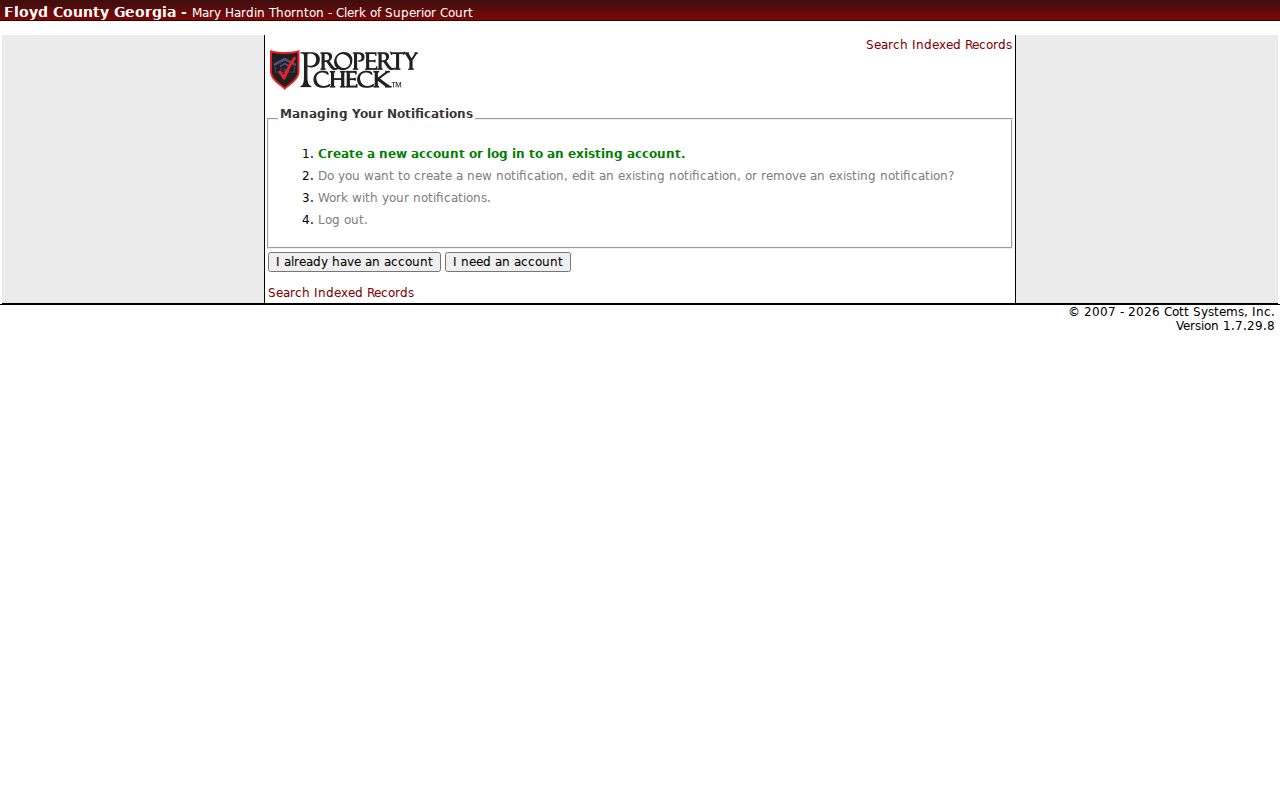
The index gives the next reference. Only the image shows whether the instrument actually transferred the subject land.
Floyd Zero-Price Sale Rows
The assessor sample holds a warning. It includes two 2022 Floyd sale rows priced at zero, each carrying reason or qualification codes. That is a county-specific caution. A zero-price row does not prove a giveaway. Family transfers, corrections, foreclosures, and administrative instruments can look alike in a summary.
Use the sale date as a deed-index lead. The image, transfer-tax material, and legal description can then show what changed, and a changed parcel ID calls for comparing acreage and map shape as well.
Floyd Estate Owner Transitions
Death breaks a clean buyer-to-seller chain. Search the decedent, the estate, executor, administrator, heirs, year's-support terms, and later grantees. Floyd Probate Court notes that Georgia Probate Records covers categories from 2006 forward. Older records can require the clerk, microfilm, or archive routes.
A probate order or appointment explains who held authority. The recorded administrator's, executor's, or heir deed proves the transfer. Vital records carry separate eligibility rules. Use only the public, property-relevant part of that chain.
Floyd Deed Book F Survives
Floyd County dates to 1832. Rome became the county seat in 1834. The Georgia Archives Virtual Vault holds a surviving volume: Floyd Deed Book F, covering 1848 through 1850 and including pages 74 and 75. Faded ink makes exact transcription slow work.
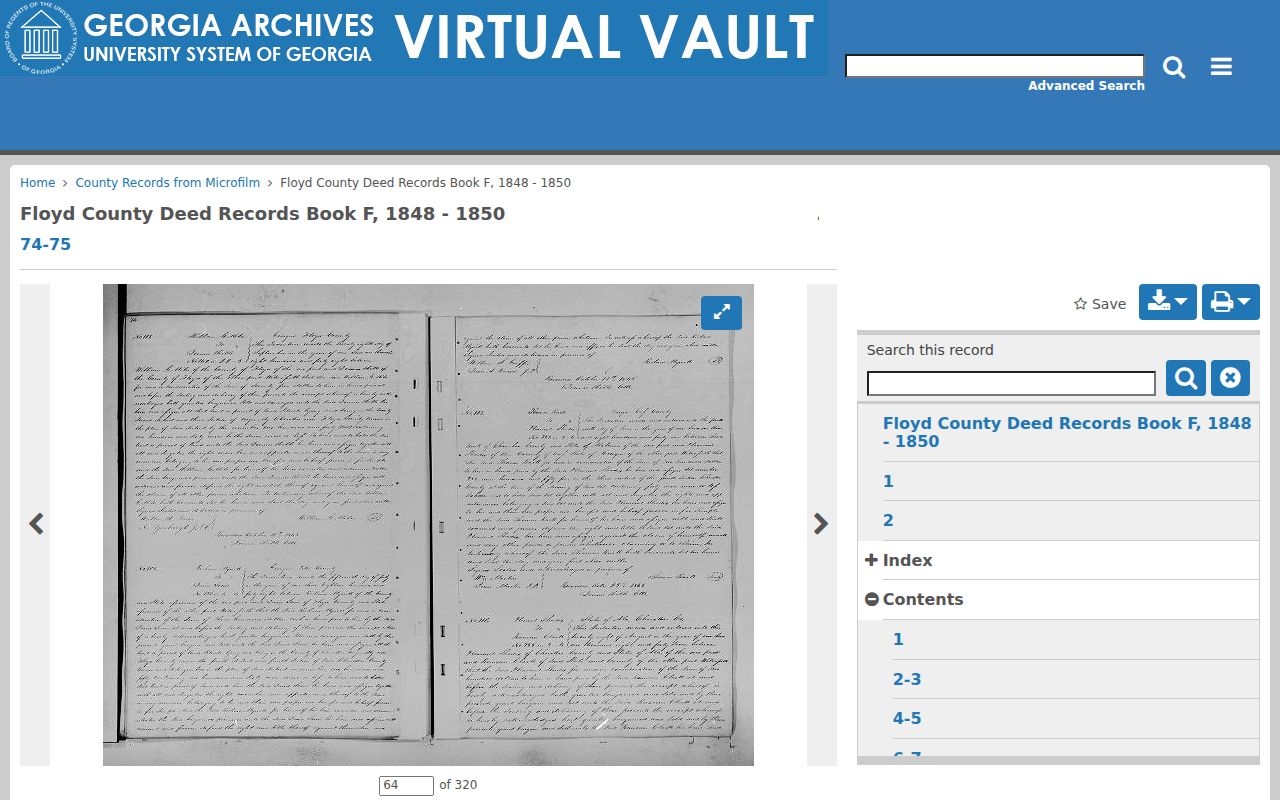
A saved volume and page beat a loose former-owner name when online coverage ends. That is the lesson of this archive image.
Plats Anchor Floyd Past Owners
Plats bridge old tracts and new lots. Search subdivision, block, lot, surveyor, and plat book/page. Rome historical plats and Superior Court recorded plats are the usual sources, while rural deeds lean on land lot, district, section, metes and bounds, and adjoining owners instead. The legal description outlives the street address.
City directories and newspapers add occupancy context, not title. The Rome-Floyd County Library Heritage Room holds local history, microfilm, yearbooks, newspapers, and special files. Record the year, issue, and page, and keep an occupant distinct from a former owner.
Note: A directory resident or business at an address may have occupied the land without owning it.
Post-Fire Floyd Record Access
Fire struck the Historic County Courthouse on March 23, 2026, and a Superior Court judicial emergency followed. The official order names no record-by-record fate. Damaged, destroyed, and relocated record groups are not itemized, so the fate of any given deed book stays open. Do not claim a loss without written confirmation.
Call the Clerk before traveling. Give the exact book/page and ask whether the item sits at a relocated counter, an image system, GSCCCA, local storage, or another repository. Put document type, parties, and copy needs in writing.
Depth of Floyd Ownership Records
Floyd County's online ownership trail starts around 1999, when Georgia's statewide floor begins. The county's paper history runs far deeper. Deed books, grantor and grantee indexes, plats, tax digests, probate files, and microfilm all hold chains of title. These reach back well over a century.
Microfilm carries the oldest material. The Georgia Archives notes that most pre-1900 Superior Court and Probate records survive on film there. This covers counties like Floyd. Its finding aids point to the right reels. When a name never appears online, the local Deed Room and the Heritage Room still serve as fallback channels. Both remain reliable options.
Lawful use. Research Floyd County former owners for house history, title work, an estate, or purchase diligence. Never use past names or addresses to harass or target anyone.
Label each finding as you go. A recorded deed fact deserves its own tag. So does a tax-roll fact. A historical occupancy clue or a plain inference deserves the same treatment. That discipline keeps the work honest.
Walk the chain backward with dates attached, not as a claim of present title. For ordering copies, the Floyd County deed records page spells out the mechanics.