
Identify a Floyd County Owner
Ownership here is a cross-reference, not a single-name lookup. Start with the situs address, the place where the parcel lies. Floyd qPublic ties that address to a PIN. It also names the owner of record on the assessment roll. Next, test the deed index. A newer conveyance may name a different grantee, so keep the dates from both systems.
- Search the complete address in Floyd qPublic and copy the parcel ID, owner spelling, situs, and mailing address.
- Search that owner as grantee in Floyd PropertyCheck or GSCCCA. Find the latest deed tied to the same legal description.
- Compare recording date, deed book/page, and grantee with the assessment card's upload or certified-roll context.
- If an LLC owns the parcel, check its exact legal name in Georgia's corporation record. If an estate appears, check Floyd Probate records.
This answers ownership in official records. It does not show who lives there. A tax mailing address can differ from the property address, and a business may occupy land owned by someone else.
Floyd County Tax-Roll Owner
The Floyd County Board of Assessors maintains the parcel card used for tax administration. A sample card lists the Parcel ID, class, taxing district, acres, owner, mailing and physical addresses, assessed value, coded sale rows, dates, and an aerial outline. qPublic notes that its data comes from the last certified tax roll and is not for legal documents. The owner field is a strong first answer. It is not the final title answer. Copy the name exactly as printed, including co-owner initials, ampersands, trust wording, and company suffixes. Save that spelling first. Then search name variations.
Floyd County Ownership Sources
Each public source speaks from its own record date and purpose. The assessor carries the tax-roll contact. The Superior Court Clerk keeps the recorded instrument, while GIS offers a spatial handoff and state corporation records explain an entity name. That never turns a registered agent into the landowner.
| Where Ownership Appears | What It Gives | Currency Clue |
|---|---|---|
| Floyd qPublic | Owner of record, mailing address, situs, PIN | Certified-roll context and upload date |
| Cott / GSCCCA deed index | Grantor, grantee, instrument and book/page | Newest matching recording date |
| Rome-Floyd GIS | Parcel shape and Property Card route | Layer update metadata |
| Georgia SOS Business Search | Entity status, agent, officers and filings | Corporation filing date, not title date |
A fresh deed usually beats a stale roll. It carries newer evidence of a recorded transfer. Even so, a deed index hit must match the same parcel or legal description, because a shared name alone is not enough.
Trace Ownership to Floyd Deeds
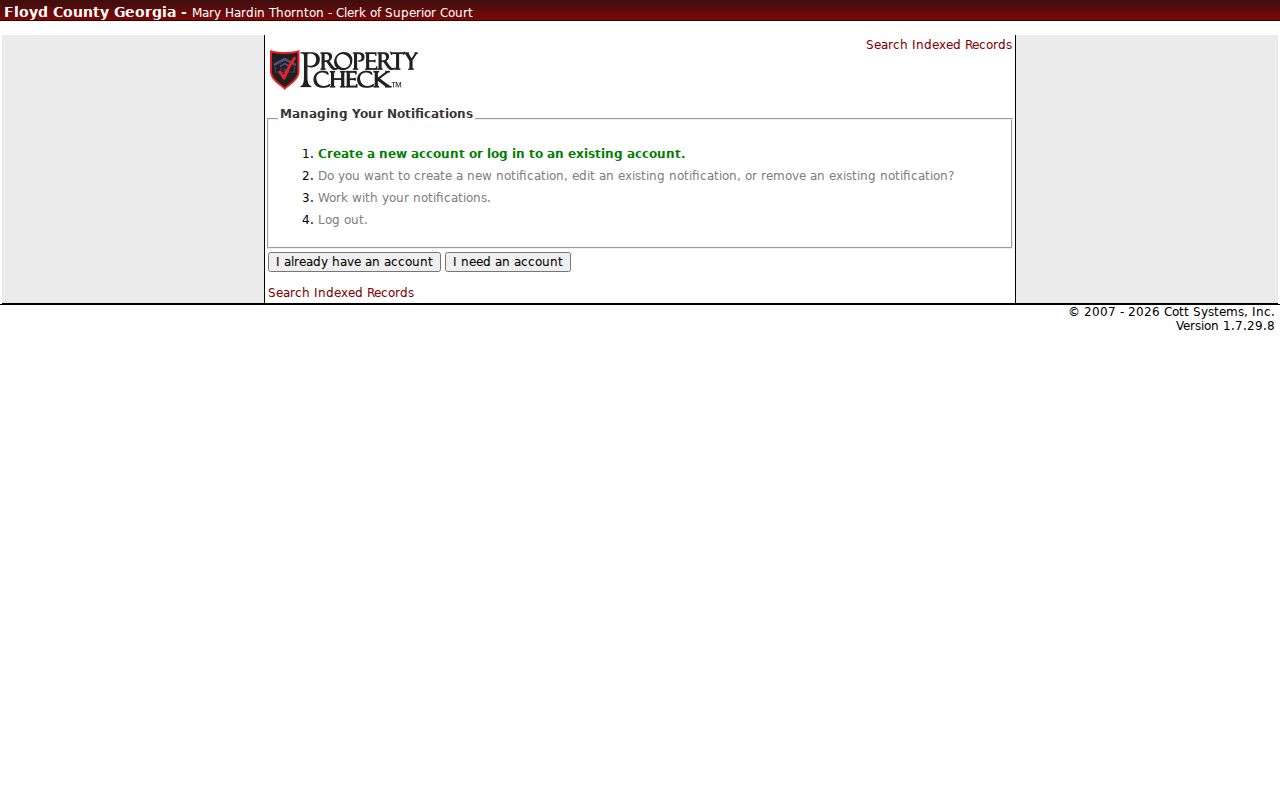
Floyd County's recorded-instrument authority is the Clerk of Superior Court's Real Estate Records and Deed Room. Floyd PropertyCheck offers guest index access and alert functions. Document viewing and printing there sit behind a subscription. GSCCCA also supports statewide name, book/page, county, subdivision, lot, party, date, and instrument searches.
The owner hunt needs only the newest matching transfer. Search the qPublic owner as grantee, then compare its legal description with the subject parcel. A newer deed reveals its grantee and recording reference. Deeper backward chain work belongs on the former-owners page.
The PropertyCheck page also displays its notification entry point.
The Clerk's recorded copy remains the evidence to inspect.
Floyd Property Owners as Entities
An LLC, corporation, trust, or estate can hold title instead of a person. Search the full entity name with and without punctuation. The Georgia SOS Business Search accepts a business name, control number, registered agent, or officer. Its result can normalize the entity and show status or filings.
A registered agent is not the property owner. An officer's name does not replace the grantee either. For a trust, search the trust and trustee wording. For an estate, Floyd Probate Court may show the representative's authority. It shows any later administrator, executor, or heir conveyance.
- Owner of record
- The party carried as owner in the official record being viewed.
- Grantee
- The party receiving the interest in a recorded deed.
- Situs address
- The physical location of the land, distinct from tax mail.
- Title
- The legal rights in land, which a name lookup alone does not prove.
Address Clues for Floyd Ownership
Floyd addresses often carry SE, SW, or NE directionals. Keep them. A Rome, Lindale, Shannon, or Cave Spring mailing label may not settle city jurisdiction. Use the assessor taxing district and the Rome Boundary layer in the joint GIS viewer to confirm the parcel.
Mailing and situs fields answer separate questions. The situs locates the property. The mailing address routes tax notices, and it can belong to an owner, trust, manager, or other authorized recipient. Neither field proves occupancy. When street text varies, the parcel number is the safer link.
Note: ZIP codes are postal areas and can cross city lines, so they should not decide Rome or county jurisdiction.
When Floyd Owner Names Conflict
Timing often explains a mismatch. The qPublic card reflects the certified roll and later uploads, while a deed can record after that source date. Compare two clocks. Check the deed's recording date against the card's upload or creation date. A coded sale row is just a prompt. The sample card shows two zero-price rows. Neither should be called a gift or no-consideration sale without reading the deed itself.
A split or merger can also move the answer. Match acreage, legal description, taxing district, map shape, and prior PIN when available; if the evidence stays mixed, state both names with their source dates rather than forcing one unsupported conclusion.
Offline Floyd Owner Records
When online tools fall short, the search still has legs. The Deed Room takes written requests that name the document type and its book and page. Its local deeds page posts the ordinary and certified copy fees. Older material can live in deed books or on microfilm. It can also sit at the Georgia Archives or in the Rome-Floyd County Library Heritage Room. County administrative records follow a separate route through Floyd County NextRequest.
Call ahead before any courthouse trip. The March 2026 fire at the Historic County Courthouse triggered a judicial emergency. No full inventory of damaged or relocated volumes exists. So ask where the book you need is being served. Also ask whether a public terminal or certified copy is available that day.
Limits of a Floyd Owner Lookup
An owner name is only a starting point. A Floyd County parcel record will not tell you who lives at the property. It will not say whether title is marketable, or whether every lien was released. Boundary questions stay open too. Trusts and companies may lawfully keep a person off the owner line. Georgia VoteSafe shields qualifying voter registration addresses. The county removes no deed or parcel from public view merely because someone asks.
A Floyd County owner lookup answers one question, and only that one. Title, releases, exceptions, and priority call for a Georgia attorney or title professional. For a sharper view of today's tax roll, see the current owner record. Turn to prior deeds only when the question shifts to history.
Lawful use. Use Floyd County owner records for a purchase, boundary question, estate matter, deed-fraud check, or civic research. Never use them to harass, threaten, or target a person.
A Floyd County owner lookup answers one question, and only that one. Title, releases, exceptions, and priority call for a Georgia attorney or title professional. For a sharper view of today's tax roll, see the current owner record, and turn to prior deeds only when the question shifts to history.